21 East Street
Overview
History
East Street is one of the four arms of the medieval street pattern of Faversham, Kent, and the shortest of them. Although some evidence of its medieval origins survives in buildings at its western end, much of the present streetscape dates from the nineteenth and twentieth centuries. The construction of Crescent Road in the 1960s effectively divided East Street into two sections, the western retaining its commercial character and the eastern becoming predominantly residential.
Archaeological excavations behind 17–19 East Street in 2007 revealed evidence of medieval occupation, including a flint-paved courtyard and rubbish pits. By 1865, houses lined both sides of the street, which formed part of an expanding residential area. East Street thus retains the character of a historic thoroughfare whose buildings reflect successive periods of development.
No. 21 stands within the Faversham conservation area, but no individual statutory or local heritage listing has yet been identified.
John Loughborough Pearson was commissioned to undertake repairs to the house for Dr Thomas Charles Spyers in 1865. No details of the work have so far been established.
External Description
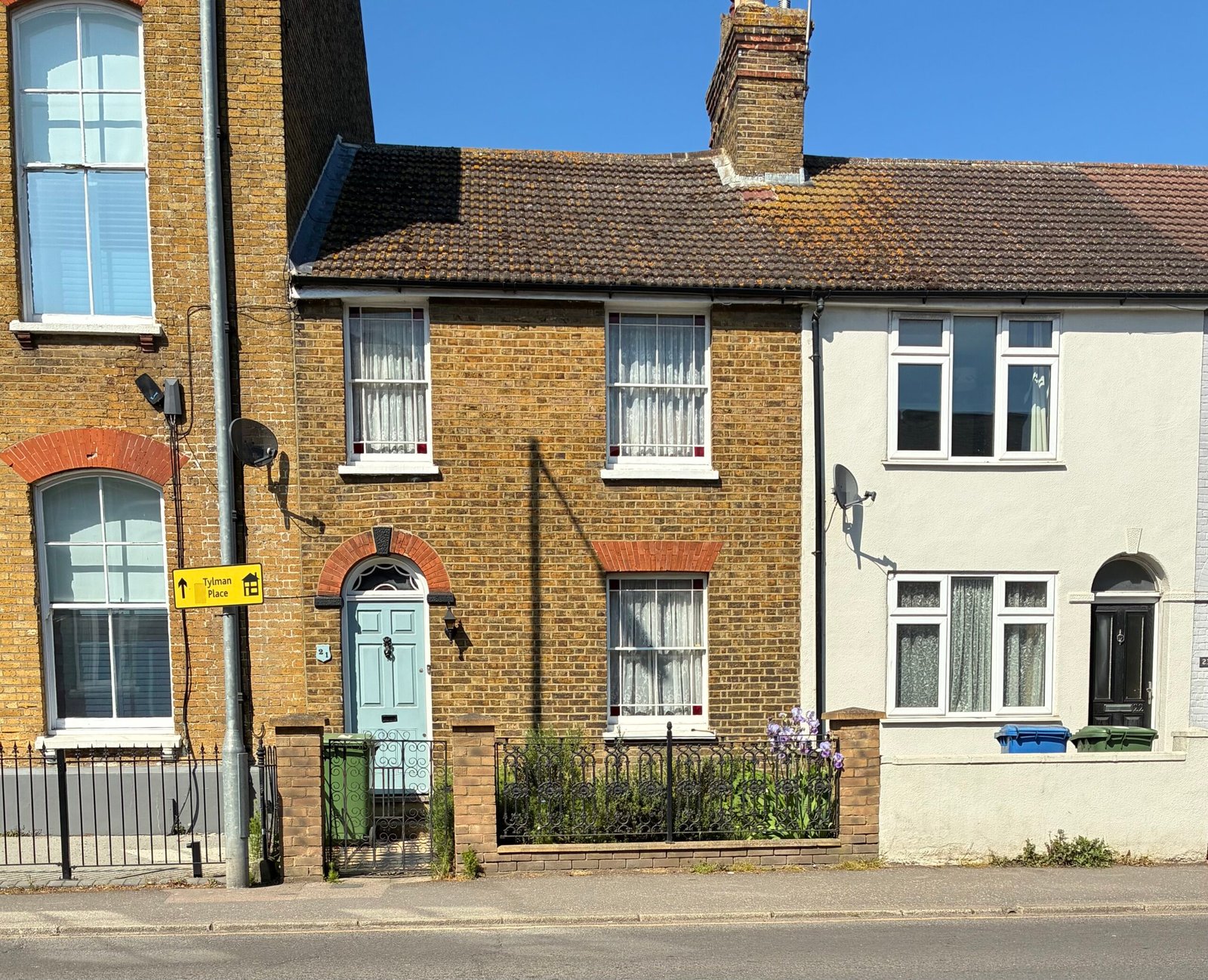
No. 21 is a modest two-storey terraced house, constructed of yellow-brown stock brick with red brick dressings and a pitched roof apparently covered in clay tiles. There is a substantial brick chimney stack. The front elevation has two sash windows to the first floor and one to the ground floor, all with glazing bars. The ground-floor window has a shallow segmental arch of red brick.
The most decorative feature is the entrance, with its round-headed red-brick arch, contrasting dark blocks at the crown and springing points, and fanlight with curved glazing bars. The panelled front door is painted pale blue-green. A small front garden is enclosed by a low brick wall with iron railings and a gate.
Internal Description
This is a private residence, and the interior was not available for inspection.
Analysis
Pearson’s work at 21 East Street, Faversham, seems at first glance to be very unimportant: unidentified minor repairs to a modest terraced house. However, from a personal perspective, this was a highly significant piece of work and one which may have played a role in allowing Pearson to continue his architectural career.
The work was commissioned by Pearson’s very close friend, Dr Thomas Charles Spyers. Their friendship began when, in 1846, the young Pearson designed the church of St James, Weybridge. The work was heartily supported by Dr Spyers, who was churchwarden and also a clergyman who ran a local school at Halstain House. The two became firm friends. It was Spyers who married John and Jemima Pearson in 1862 at Hampstead Parish Church.
Tragically, on 25th March 1865, Jemima died, probably of typhoid fever. A week later, Pearson visited his friend Spyers at his country house, Wallop Lodge in Hampshire. Pearson had already begun restoration work at Wallop Lodge, but in the bleak period following his wife’s death, this project became a major focus for him. This was also true of his ongoing work at Halstain House, again for Spyers. In addition, Spyers asked Pearson to undertake the work at 21 East Street. Anthony Quiney remarks that this was ‘no doubt part of Spyers’s plan to start Pearson working again after the death of his wife.’
This was clearly a very significant friendship for Pearson. He referred to ‘dear Doctor Spyers’, his son Frank went to school at Halstain House, and John was devastated by Spyers’s death in 1881.
The importance of personal friendships in professional life cannot be overstated. We have no way of knowing what the result of the desolation of grief might have been for Pearson and his work without Spyers’s kindly intervention. Would we have mighty Truro Cathedral without lowly 21 East Street, Faversham?
Gallery


References
Historic England. ‘17–19 East Street, Faversham.’ National Heritage List for England, List Entry No. 1343840.
Kent County Council. ‘A Medieval Yard Surface at 17–19 East Street, Faversham.’ Kent Historic Environment Record, Monument No. MKE43112.
Newman, John. Kent: North-East and East. The Buildings of England. New Haven and London: Yale University Press, 2013 (reprinted with corrections 2019; reprinted 2023).
Quiney, Anthony. John Loughborough Pearson. London: Yale University Press, 1979.
Reid, Patricia. Report on a Medieval Yard Surface and Rubbish Pits in East Street, Faversham, Kent. Unpublished archaeological report, 2009. Kent Historic Environment Record, Source No. SKE15863.
Swale Borough Council. Faversham Conservation Area Character Appraisal. Chapter 9, ‘East Street, Church Road and Orchard Place’, 2004.